Taith i Bosworth / Journey to Bosworth
Following the journey of Henry Tudor.
———————————————————————————————————————————–
07.08.1485 Henry Tudor arrived at Milford Haven on 7 August just before sunset, landing in Mill Bay at Dale, though Richard III believed that the landing was at Angle for an advance on Pembroke and Tenby castles, and had kept a close watch on during the winter. His letter to Henry Vernon of 11 August suggests a subsidiary landing at Angle. This ‘decoy’ landing may have misled Richard to expect a Henry’s advance through Pembroke and Carmarthen to southern England. But Henry’s route had been carefully chosen to obtain the maximum support from Wales and the Marches before successfully entering England at Shrewsbury.
———————————————————————————————————————————–
08.08.1485 At day-break on the 8 August, Henry Tudor’s forces left Dale for Hwlffordd, twelve miles away, and without opposition, continued to five miles beyond the town. The Tudors connection with Penfro was immediately in their favour. According to Polydore Vergil, ‘here he was received with great goodwill by the men’. He was joined by Arnold Butler of Coedcamlas [near Penfro] who brought a few men and pledged citizens of Penfro ‘who were ready to serve Jasper as their earl’, and told Henry Hwlfffordd’s people ‘were ready to support Jasper their earl’.
Here though, he was told that Rhys ap Thomas and Sir John Savage were hostile to him. The success of Henry’s venture now depended on whether he could march through Wales without meeting serious opposition from Richard III’s forces. The rumor that Walter Herbert and Rhys ap Thomas were at the head of a large force loyal to Richard III at Caerfyrddin. They were in fact there, but not loyal to Richard. Henry’s scouts soon reported that all was quiet.
From near Hwlffordd, Henry departed north-eastwards for Aberteifi, twenty-six miles over the Preseli Hills. The route chosen by Henry and Jasper, within six days from Dale brought them to the gates of Shrewsbury, about 150 miles away. Henry was soon joined by Richard Griffith, ‘a man of high parentage’, and by his pledged supporter, John Morgan. The march continued under the Red Dragon of Cadwaladr, later described by the Tudor chronicler Edward Hall as ‘a fiery dragon beaten upon green and white sarcenet’.
After crossing the Preseli Hills at Bwlch-y-gwynt [SN 075321], Henry’s resting place for 8 August was traditionally at Fagwr Lwyd south of Cilgwyn, and lies in a commanding place about a mile north of the Aberteifi road. The ruins of the farm are by a clump of tall beach trees visible for many miles around SN 0734.
———————————————————————————————————————————–
09.08.1485 On the 9 August, Henry crossed the Teifi at Aberteifi under the walls of the castle, and here, received the town’s support and has supposed to have rested briefly at the Three Mariners.
At about this stage, Henry sent a message to his mother, Lady Margaret Beaufort, and to the Stanleys telling them of his intention to cross the Severn and advance through Shropshire to London. But Thomas Lord Stanley, Lady Margaret’s 2nd husband, steward of Richard III’s household, had to be careful. He was only allowed to depart to his Lancashire [Latham] by sending his son, George, Lord Strange, as a hostage to Richard III at Nottingham. Richard was there in June 1485, not being sure where Henry Tudor would land. The King sent for the Great Seal to facilitate the array of his forces at the end of July.
When Henry entered Aberteifi, a similar rumor reached him that Rhys ap Thomas and Sir Walter Herbert were at Caerfyrddin prepared to challenge his progress. These were likely to have been spread by Rhys ap Thomas to put Richard III off guard, but caused him some anxiety. ‘He resolved to go against them, and when he had either put them to flight or received them into his obedience, to make haste against king Richard III’. He sent out a body of cavalry, but they soon returned with the information that no danger was to be from Caerfyrddin. On the contrary, Richard Griffith, ‘a man of high parentage’, joined him with reinforcements from there. Richard Griffith is said to have ‘revolted’ to Henry Tudor, for which we are to infer, presumably, that the troops there with Rhys ap Thamas and Herbert were supposed to be loyal to Richard III. Sir John Morgan also came with a few followers. Was it with, or without, the connivance of Rhys ap Thomas and Herbert that these two men joined Henry Tudor? Polydore suggests that it was without their connivance; and that Henry Tudor, when he left Aberteifi for Shrewsbury, was uncertain of their allegiance. On the other hand, there can be little doubt that Rhys intended ultimately to attach himself to Henry.
From Aberteifi, Henry continued to advance along the coastal route in the direction of Aberystwyth and Machynlleth. There is a local tradition that his forces stopped for watering at Ffynnondewi at the fourteenth milestone north-east of Aberteifi. An even firmer tradition, accepted by many, asserts that Henry Tudor stayed the night in Llwyndafydd, probably at the house called Neuadd, which stands high over a narrow, secluded valley down to Cwmtydu, about two miles south of Ceinewydd. Henry’s host at Llwyndafydd was Dafydd ap Ieuan, a descendant of Cadifor ap Dinwal, Lord of Castell Hywel in south Ceredigion, himself a descendant of the famous chieftain Tudwal Gloff, son of Rhodri Mawr. At Llwyndafydd, if the tradition is believed, Henry was entertained in high style. After his accession Henry sent his former host at Llwyndafydd a hirlas, or drinking horn.
———————————————————————————————————————————–
10.08.1485 Following his overnight stay at Llwyndafydd, continued to Llanbadarn. Henry is reputed on the 10 August to have stopped the night at Wern Newydd, barely four miles from Llwydafydd in the adjacent parish of Llanarth. But as he averaged over twenty miles a day during the march through Wales, this particular stay is unlikely. There is little doubt that on 10 August, camp was pitched by local tradition at Llanilar church, south-east of Aberystwyth and that, Henry slept in the old mansion of Llidiardau nearby.
A stop at Llanilar on the night of 10 August 1485 would have made good sense. On the next day Henry’s men could then have circumvented the royal castle at Aberystwyth by marching northwards through the ancient settlement of Llanbadarn.
———————————————————————————————————————————–
11.08.1485 The route from Llanilar to Llanbadarn is now not possible by road but from there the road north leads directly to the Dyfi estuary and on to Machynlleth. Henry did not stay at Machynlleth but turned eastwards, for his night stop of 11 August at Mathafarn, the home of Dafydd Llwyd, about five miles east of Machynlleth. Dafydd Llwyd, of the Welsh poets, was most prominent in advancing Henry Tudor’s cause. At Mathafarn, Henry is supposed, according to tradition, to have consulted with the seer over the outcome of his bid for the throne, who prophesied victory for Henry Tudur, and was made an Esquire of the Body after Boswerth by Henry VII.
At about this stage of Henry sent a message to Rhys ap Thomas promising him a perpetual lieutenantship of Wales for his allegiance. Polydore Vergil leaves the impression that Henry was uncertain of Rhys’s intentions during this initial stage of the march to Bosworth.
It seems to have been arranged that when news of Henry Tudor’s landing would be passed through Caerfyrddin on its way to Richard’s headquarters at Nottingham, it would be suggested that Rhys ap Thomas and his army would oppose Henry Tudor, in order that Richard III might be lulled into a sense of false security, as indeed he was, for though he heard the news on the 11 August 1485, he did not move until 15th August.
Events were soon to show, however, that Rhys must have begun his own advance towards Shrewsbury within a very short time of Henry’s landing. There is no evidence that Rhys met Henry at Dale. Rather, Rhys ap Thomas’s starting place for his march north was probably Caerfyrddin. From there, Rhys ap Thomas advanced up the Tywi valley to Llanymddyfri, and so eastwards to Aberhonddu. These three towns are all mentioned in the family ‘Life’ as being on his line of march, and states that at the beginning of his march he ordered warning beacons be lit to summon his forces to meet him along his prepared route, ‘some in one place and some in another on his way to Shrewsbury …. His snowball gathering more and more in the rolling….’
It is recorded thar at Aberhonddu he gained support from Vaughan and Gam families of the March. Rhys also detached a force of cavalry to act as a rearguard in case of disaster. In spite of the partisan origins of the ‘Life’, these details of Rhys’s march north in support of Henry Tudor remain convincing.
From Aberhonddu Rhys and his army turned north across the Epynt hills to Llanfair-ym-Muellt. John Lloyd of Dinas, Llanwrtyd probably joined at Llanfai-ym- Mualltr. The route north may have taken Rhys to Rhayader and to the Severn valley at Llanidloes, but more likely it followed the Roman road from Aberhonddu through Buellt and the Roman through Castell Collen to Caersws. From there to Y Drenewydd, and Y Trallwng was relatively easy.
11.08.1485 Richard III was at Nottingham Castle, his military base and one of his favorite residences, when, on 11 August, came the news that Henry Tudor had landed in south Wales. It appears certain that either Richard Williams at Pembroke or one of his officers had learnt of Henry’s landing at Bull Bay almost immediately and then taken steps to inform Richard III. The speed at which this information was carried within four days to Richard at Nottingham, about 200 miles from Penfro, was remarkable. Evidently in the person of Richard Williams, Richard III had at least one loyal adherent; Williams fought on the King’s side at Bosworth and was later attained.
On 11 August 1485, from Beskwood Lodge near Nottingham, Richard III wrote to Henry Vernon, one of his Esquires, to inform him that ‘rebels and traitors accompanied with our ancient enemies of France’ had landed at Nangle besides Milford haven in Wales on Sonday last passed, as we be credibly informed, entending oure utte destruction, the extreme subversion of this oyre realme …’ Richard called on Vernon ‘horsed and harneised’ to rally to him ‘in all hast to you possible …’
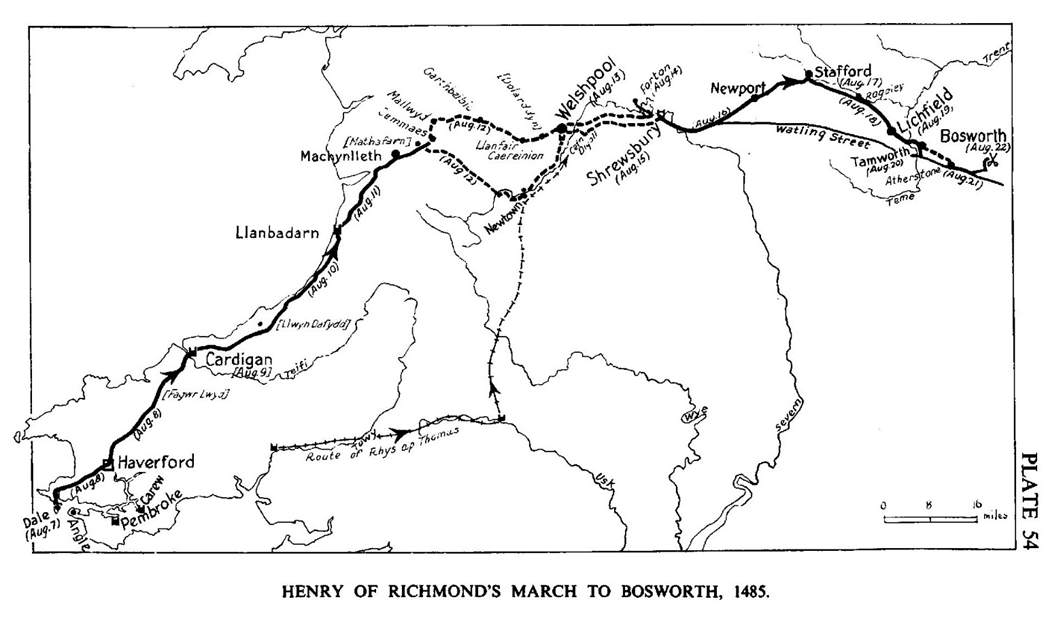
William Rees’s map shows the routes from Llanbadarn to Machynlleth and then on to Mathafarn in the Dyfi valley.
———————————————————————————————————————————–
12.08.1485 William Rees indicated that two possible routes were taken from Mathafern to Caersws, then Y Drenewydd and Y Trallwng, and from Mathafern to Camaes and then Mallwyd to Garthbeibio, Llanfair Caereinion, Dolarddyn to Y Trallwng.
After leaving Mathafarn on the 12 August Henry Tudor marched northwards to Mallwyd and then east through the pass of Bwlch-y-fedwen to Castell Caereinion. Here, where he was within strtiking distance of the Severn valley, he spent the night of 12 August, according to tradition at Dolarddun.
A second force may have marched south-eastwards from Mathafarn to link with Rhys-ap-Thomas’s near Y Drenewydd.
———————————————————————————————————————————–
13.08.1485 The following day 13 August, after spending the previous night at Dolarddwn , Henry advanced 6 miles to Y Trallwmg. He then went on to Cefn Digoll [Long Mountain], which overlooks the Severn opposite Y Trellwng. Here he met Rhys ap Thomas ‘with a great band of soldiers’ and with assured promises of loyalty yielded himself to his protection’ [Ploydore Vergil]
Other Welsh contingents from north and north-east Wales also met Henry on Cefn Digoll. These included the followers of William Griffith of Penrhyn [near Bangor] and of Richard ap Hywel of Mostyn in Fflint. Another prominent supporter of Henry was Rhys Fawr ap Maredudd of Plas Iolyn in the upper Conwy valley.
In addition to those who joined Henry in formal groups, other Welsh squires had joined him on the march from all over Wales, from Caerfyrddyn and Ceredigion, from Meirionydd and Ynys Mon; from Morgannwg, Cydweli, Gwyr and Trefynwy. Many of these supporters were later rewarded by grants or awards of local offices. Somewhere along the route to Bosworth Henry was joined by David Cecil [Seisyll] a young squire from Alltyrynys in the border lordship of Ewyas Lacy. He was the ancestor of William Cecil, Lord Burghley, the greatest of all the counsellors of the Tudors.
Following this significant reinforcement of his army on 13 August 1485, Henry’s combined forces camped the night on Cefn Digoll.
———————————————————————————————————————————–
14.08.1485 Rhys ap Thomas from Caerfyrddin to Cefn Digoll was spent recruiting his army, as far as Richard knew, to shadow and oppose him but he met and joined him on Cefn Digoll.
When Henry reached Shrewsbury, about 14 August, he found the gates shut and the portcullis down, and so he fell back to Forton for the night.
Messengers were sent to Shrewsbury asking for admission. But the senior magistrate, Thomas Mytton, refused entry. The town gates were closed and Henry Tudor’s army remained for the night near Forton, Henry sleeping in the village.
———————————————————————————————————————————–
15.08.1485 15 August, Thomas Mytton and his magistrates after further negotiation with Henry opened the gates of Shrewsbury. Henry’s army was welcomed, and the day was spent recruiting.
In one week, 7-14 August, Henry had marched his Breton/Welsh army 150 miles from Dale to Shrewsbury, a march that had carried his force close to the heart of England. The first stage of his campaign to win the crown was thus over. Over 80% of Henry’s army were Cymry. On 22 August 1485 the Cymry invaded and defeated an English Army and put a Mab Darogan on the throne of England.
Dr John Davies